
Join the Movement
Sign up for monthly updates and access to resources to scale community justice workers in your state. You can unsubscribe at any time.

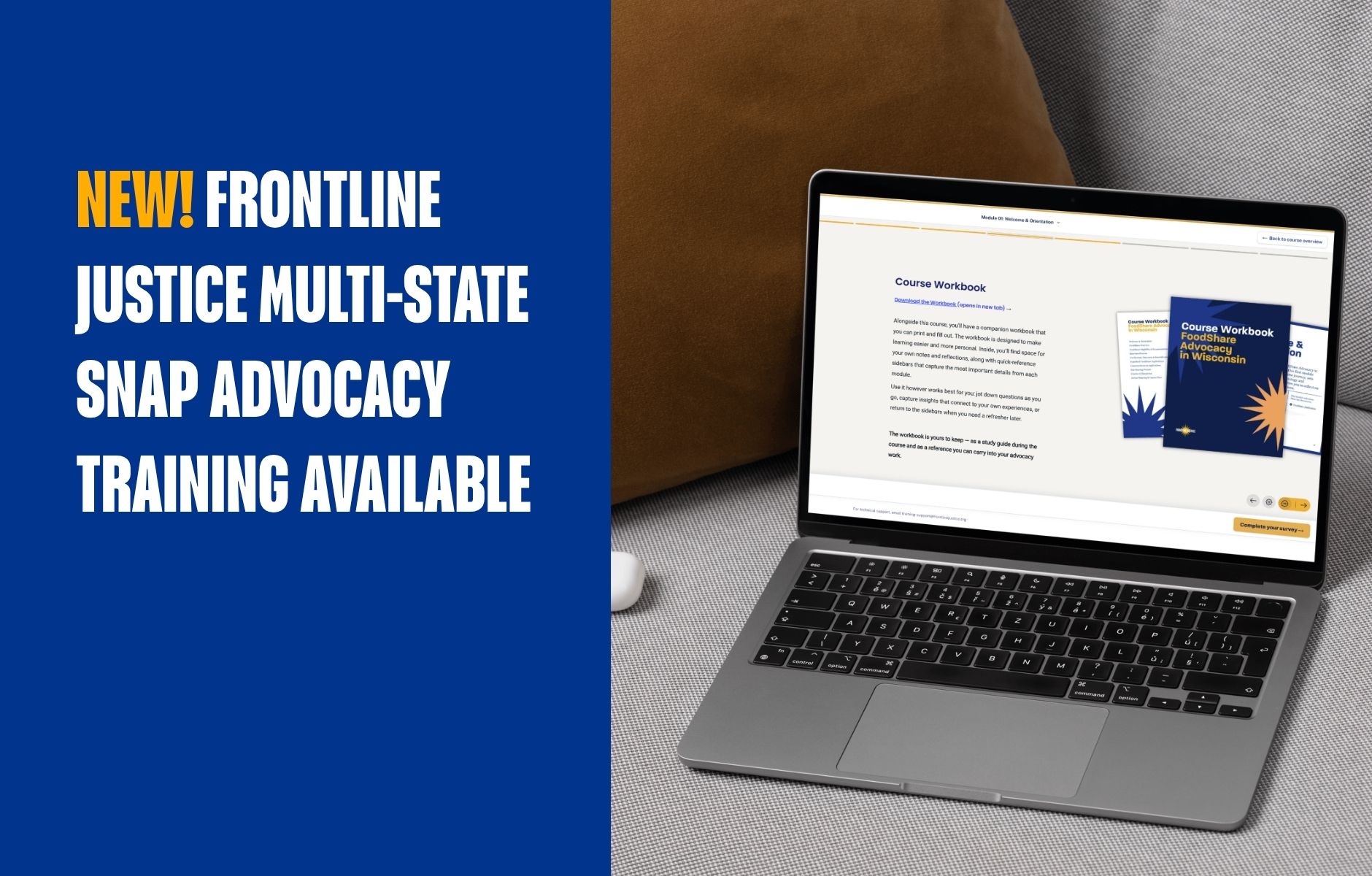
NEW YORK, NEW YORK – October 5, 2026 – Frontline Justice has launched a new self-paced training to equip frontline workers with the knowledge and skills to help people who may be entitled to Supplemental Nutrition Assistance Program (SNAP) benefits but have been wrongfully denied, had their benefits erroneously reduced, delayed, or cut off.
With families facing imminent benefit cutoffs from administrative hurdles and processing errors as new federal laws are rolling out, the stakes have never been higher. Every wrongful denial or delay inflicts immediate hardship on vulnerable households. This training empowers community justice workers to recognize these critical failures and immediately navigate the path to resolution.
Recent reports discuss these challenges, including “Arizona’s push to lower SNAP errors reaches people’s daily lives,” “Alaska’s persistently high SNAP payment errors top nation for fourth consecutive year,” “Waste Watch uncovers $826 million SNAP problem for Texas taxpayers, and it's not fraud,” and “Wisconsin’s SNAP error rates are low, according to federal review.”
With changes to federal SNAP requirements, states may also absorb more financial penalties and administrative costs related to SNAP errors. Currently, 41 states are above the 6% federal payment error threshold, putting many states at risk of taking on 5%, 10%, or 15% of benefit costs, beginning as early as October 2027. This training enables community justice workers to spot issues and address them early, helping states address problems that contribute to inaccurate payments and improve payment accuracy.
Who are community justice workers? Community justice workers are trained, community-based helpers (shelter volunteers, community health workers, and other trusted advocates) who can assist people with everyday legal and life challenges like unlawful evictions, wrongful public benefits denials, custody issues, medical debt, or domestic abuse. Just like paramedics, nurses, and home aides have expanded access to basic health needs, community justice workers are meant to do the same for the justice system.
The SNAP training structure is based on the model used by the Alaska Community Justice Worker program, which has already recovered over $23.6M in SNAP benefits and achieved a 100% success rate in SNAP eligibility assessments. With help from in-state subject matter experts (SMEs), trainings for Alaska, Arizona, Wisconsin, and Texas are localized to meet each area's needs.
Those interested in updates on when SNAP training expands to their area can join the waitlist.
Frontline Justice, a national initiative aiming to rapidly grow the community justice worker workforce, designed these trainings to meet people's urgent needs. Frontline Justice encourages frontline community organizations to partner with legal aid organizations that can take referrals for complex cases. This pathway helps organizations grow their capacity and reach more people without relying solely on a limited number of attorneys. The self-paced virtual training format makes it easier for community-facing advocates to fit into their busy days.
An earlier pilot of this training demonstrates its effectiveness, with learners describing it as clear, accessible, and more useful than attorney-oriented materials. On a scale of 0–10, learners rated the training a 9.5 for how likely they are to recommend it to a friend or colleague, citing meaningful content, quality learning objectives, and accessible language.
Once someone has taken the training and starts helping their community, they may be interested in a human-in-the-loop AI assistant called Frontline Q. Earlier this year, Frontline Justice and Josef partnered to test this tool with partners in Alaska, Arizona, and Texas. Frontline Q assists community justice workers by providing instant, practical answers to common SNAP advocacy questions, such as eligibility rules, so they can help families access the benefits they are legally entitled to. The platform brings together reliable federal, state, and local SNAP information, with answers reviewed and verified by subject matter experts.
Next steps include Frontline Justice’s plans to scale SNAP training nationwide to support the millions of Americans who are at risk of losing benefits even though they qualify. Visit our website to learn more about training enrollment, and join the waitlist to get notified when the training becomes available in other states.
Nikole Nelson
CEO, Frontline Justice
References:
Martichoux, Alix. 2026. “41 States at Risk of Losing Federal SNAP Funds, New Data Shows: What to Know.” The Hill.
U.S. Department of Agriculture, Food and Nutrition Administration. 2026. “Supplemental Nutrition Assistance Program: Payment Error Rates, Fiscal Year 2025.” Washington, DC: U.S. Department of Agriculture.
Matthew Burnett, Rebecca L. Sandefur, and James Teufel. 2025. “Research Brief: Analysis of the Social and Economic Impact of the Alaska Community Justice Worker Program (2021-2025).” American Bar Foundation Access to Justice Research Initiative. Chicago, IL: American Bar Foundation.